

Case Study
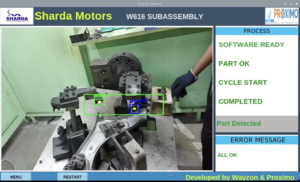
AI Vision-Based Child Part Presence Verification and PLC Interlocking System for Error-Proof Automotive Assembly
🏭 Industry
Automotive Manufacturing – Assembly Line Poka-Yoke Inspection
🧩 Problem Statement
During manual assembly operations, operators are required to install several child components onto the main assembly before the next manufacturing process begins. Missing or incorrectly assembled child parts can lead to serious quality issues, rework, warranty claims, and production losses.
Traditional inspection relied on operator confirmation, making the process vulnerable to:
- Missing child parts
- Wrong assembly sequence
- Human inspection errors
- Machine operation without complete assembly
- Lack of digital traceability
The customer required an intelligent vision-based solution that verifies the presence of the child part before allowing the PLC to start the next operation.
🎯 Project Objective
- Detect the presence of the required child part.
- Prevent machine operation if the child part is missing.
- Provide real-time visual feedback to the operator.
- Display warning messages on both PLC HMI and IoT Vision Screen.
- Send OK/NOK status to PLC.
- Ensure 100% mistake-proof assembly.
- Store inspection results for production traceability.
🛠️ Solution Overview
We implemented an AI Vision-Based Child Part Detection System integrated with the assembly station PLC and IoT monitoring software.
System Flow
- Main assembly reaches the workstation.
- PLC initiates the inspection cycle.
- Industrial camera captures the assembly image.
- AI model analyzes the predefined inspection region.
- Child part presence is verified.
- If the child part is detected:
- Green detection box is displayed.
- “Part OK / Part Detected” message appears.
- OK signal is sent to PLC.
- PLC starts the next assembly operation.
- If the child part is absent:
- Red warning box is displayed.
- “Wrong/Absent Part” message appears.
- Alarm is shown on PLC HMI.
- Alarm is displayed on IoT screen.
- PLC blocks the next process until the correct part is assembled.
- Inspection images, timestamps, operator details, and cycle status are stored in the database.
🧠 Technical Approach
- AI-based Object Detection
- Region of Interest (ROI) Verification
- Presence/Absence Inspection Logic
- Real-Time PLC Communication
- Industrial Camera Image Processing
- Automatic Inspection Logging
- Machine Interlocking Logic
- Poka-Yoke Error Prevention
Key Highlights
- 100% automatic child part verification
- Real-time AI detection
- Instant OK/NOK decision
- Green/Red visual indication
- PLC interlock for missing parts
- Dual warning on PLC HMI and IoT screen
- Automatic cycle traceability
- Fast inspection suitable for production cycle time
- Scalable for multiple child parts
🔌 System Architecture
- Industrial Camera
- LED Industrial Lighting
- AI Vision Processing System (Industrial PC / NVIDIA Jetson)
- PLC Interface (Ethernet/IP / Modbus TCP / Profinet / Digital I/O)
- PLC HMI
- IoT Monitoring Software
- SQL Database
- Manufacturing Execution System (Optional)
📊 Results & Benefits
✅ 100% child part presence verification
✅ Eliminated missing-part assembly defects
✅ Automatic PLC machine interlocking
✅ Dual warning on PLC HMI and IoT screen
✅ Reduced operator dependency
✅ Improved assembly quality
✅ Zero machine cycle with missing child parts
✅ Complete inspection traceability
✅ Reduced rework and customer complaints
✅ Production-ready AI Poka-Yoke solution
🏁 Conclusion
The AI Vision-Based Child Part Presence Verification System provides a robust Poka-Yoke solution for automotive assembly lines by ensuring that every mandatory child component is correctly assembled before the production cycle proceeds. Through seamless integration with industrial cameras, AI vision software, PLCs, and HMI systems, the solution prevents missing-part defects, enhances product quality, and enables complete digital traceability of every production cycle.
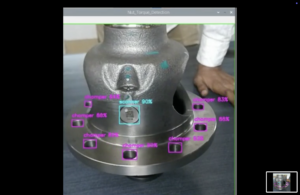
AI Vision-Based 360° Differential Housing Inspection System for Chamfer, Dent, QR Code, and Cross Mark Verification
🏭 Industry
Automotive Manufacturing – Differential Housing Quality Inspection
🧩 Problem Statement
Differential housing is a critical drivetrain component that requires inspection before moving to the next manufacturing stage. Traditionally, operators visually inspect several quality parameters, including chamfer quality, dents, QR codes, and identification marks.
Manual inspection created several challenges:
- Human inspection errors
- Missed chamfer defects
- Surface dents escaping detection
- Incorrect or unreadable QR codes
- Missing identification (cross) marks
- Lack of inspection traceability
- Increased rejection and customer complaints
The customer required a fully automated AI vision inspection system capable of inspecting every housing with high accuracy during production.
🎯 Project Objective
- Detect chamfer on all required holes.
- Verify chamfer quality and completeness.
- Detect casting dents and surface defects.
- Read and validate QR/Data Matrix codes.
- Verify presence of identification (cross) mark.
- Perform complete 360° inspection while the component rotates.
- Send OK/NOK signal to PLC.
- Store inspection images and results for traceability.
🛠️ Solution Overview
We developed an AI Vision-Based Multi-Feature Inspection System integrated with the production line and PLC for real-time quality verification.
System Flow
- Differential housing reaches the inspection station.
- Rotary fixture rotates the component.
- Industrial camera captures images from multiple angles.
- AI model simultaneously performs:
- Chamfer Inspection
- Dent Detection
- QR Code Reading
- Cross Mark Detection
- Inspection results are combined.
- If all parameters pass:
- PLC receives OK signal.
- Component proceeds to the next operation.
- If any inspection fails:
- PLC receives NOK signal.
- Component is rejected for operator review.
- Images, inspection results, and timestamps are stored in the database for complete traceability.
🧠 Technical Approach
- Deep Learning–based Object Detection
- AI Surface Defect Detection
- QR/Data Matrix Decoding
- ROI-Based Inspection
- Multi-Angle Image Processing
- 360° Rotary Inspection
- PLC Communication
- Database-Based Traceability
Key Highlights
- Continuous 360° inspection
- Simultaneous multi-feature inspection
- High-speed industrial processing
- Robust under varying lighting conditions
- Production-ready AI models
- Automatic image logging
- Easy integration with MES/ERP systems
🔌 System Architecture
- Industrial Area Scan Camera
- LED Industrial Lighting
- Rotary Inspection Fixture
- AI Vision Processing System (Industrial PC / NVIDIA Jetson)
- PLC Interface (Ethernet/IP / Modbus TCP / Profinet)
- SQL Database
- Manufacturing Execution System (Optional)
📊 Results & Benefits
✅ 100% automated quality inspection
✅ Accurate chamfer verification
✅ Reliable dent detection
✅ QR/Data Matrix verification
✅ Cross mark detection
✅ Complete 360° component inspection
✅ Reduced manual inspection effort
✅ Improved product quality
✅ Full inspection traceability
✅ Faster production cycle
✅ Reduced customer complaints and rework
🏁 Conclusion
The AI Vision-Based Multi-Feature Inspection System automates the inspection of differential housings by combining chamfer verification, dent detection, QR code validation, and cross mark detection into a single intelligent inspection station. Through continuous 360° image acquisition and AI-powered analysis, the system delivers high-speed, reliable quality inspection while seamlessly integrating with PLCs and manufacturing systems. The solution significantly improves product quality, eliminates human inspection errors, and provides complete digital traceability for every inspected component.
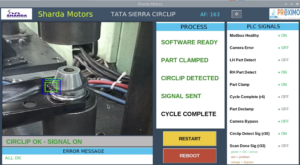
AI Vision-Based Circlip Presence Detection for Error-Proof Automotive Assembly
🏭 Industry
Automotive Manufacturing – Steering Gear / Assembly Line Poka-Yoke
🧩 Problem Statement
In steering gear assembly, a circlip is a critical retaining component that secures assembled parts in position. If the circlip is missing, improperly seated, or incorrectly assembled, the product can fail during operation, resulting in costly rework, warranty claims, and potential safety risks.
Previously, circlip verification relied on manual inspection, which was:
- Operator dependent
- Time-consuming
- Prone to human error
- Difficult to trace
- Unable to prevent missing circlips before the next process
The customer required an automated vision system capable of verifying circlip presence and interlocking the assembly station with the PLC.
🎯 Project Objective
- Detect the presence of the circlip before the assembly cycle is completed.
- Prevent the next machine operation if the circlip is missing.
- Provide instant visual feedback to the operator.
- Send OK/NOK status to the PLC.
- Display inspection status on the Vision Screen and PLC HMI.
- Store inspection results for complete production traceability.
🛠️ Solution Overview
Wayzon Technology Services Pvt. Ltd. developed an AI Vision-Based Circlip Detection System integrated with the PLC and assembly station.
System Flow
- Operator assembles the component.
- PLC triggers the vision inspection cycle.
- Industrial camera captures the circlip region.
- AI vision algorithm inspects the predefined ROI.
- The system verifies whether the circlip is correctly present.
- If the circlip is detected:
- Vision screen displays CIRCLIP DETECTED.
- Green OK indication is shown.
- OK signal is transmitted to the PLC.
- PLC allows the next assembly operation.
- If the circlip is missing:
- Vision system displays CIRCLIP NOT DETECTED.
- Red warning appears on the Vision Screen.
- PLC blocks the machine cycle.
- Operator must install the circlip before continuing.
- Inspection status, timestamps, and production data are stored in the database for traceability.
🧠 Technical Approach
- AI-Based Object Detection
- ROI-Based Presence Verification
- Real-Time Industrial Image Processing
- PLC Communication
- Automatic Machine Interlocking
- Production Traceability
- Industrial Lighting Compensation
- High-Speed Inspection Logic
Key Highlights
- 100% automatic circlip verification
- Real-time AI inspection
- PLC interlocking for missing circlips
- Green/Red visual indication
- Automatic cycle validation
- Industrial-grade reliability
- Complete inspection traceability
- Fast processing suitable for assembly line cycle time
🔌 System Architecture
- Industrial Camera
- LED Industrial Lighting
- AI Vision Processing System (Industrial PC / NVIDIA Jetson)
- PLC Interface (Ethernet/IP / Modbus TCP / Profinet / Digital I/O)
- PLC HMI
- Vision Monitoring Software
- SQL Database
- Manufacturing Execution System (Optional)
📊 Results & Benefits
✅ 100% automatic circlip presence verification
✅ Eliminated manual inspection
✅ Prevented missing circlip assembly defects
✅ Automatic PLC machine interlocking
✅ Real-time operator guidance
✅ Improved assembly quality
✅ Reduced rework and warranty claims
✅ Complete digital traceability
✅ Faster inspection cycle
✅ Industry 4.0-ready solution
Technologies Used
- AI & Deep Learning Vision
- Industrial Camera
- PLC Integration
- Industrial PC / NVIDIA Jetson
- Python & OpenCV
- SQL Database
- Industrial IoT Dashboard
- Industry 4.0 Traceability
🏁 Conclusion
The AI Vision-Based Circlip Presence Verification System developed by Wayzon Technology Services Pvt. Ltd. provides a reliable Poka-Yoke solution for automotive assembly lines. By combining AI-powered vision inspection with PLC interlocking, the system ensures that every component is assembled with the required circlip before the production cycle advances. This intelligent inspection solution minimizes human error, improves product quality, enhances traceability, and supports zero-defect manufacturing.
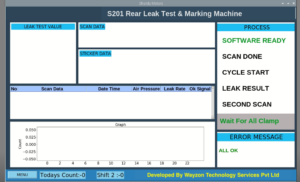
IoT-Based Data Acquisition and Traceability System for Leak Test SPM
Client Overview
Sharda Motors Industries Ltd is a leading manufacturer of automotive components, specializing in exhaust systems, suspension systems, and body structures. To enhance their quality control and traceability processes, they required an advanced data acquisition and traceability solution for their Leak Test Special Purpose Machines (SPMs).
Project Summary
The IoT-based Data Acquisition and Traceability System was deployed at Sharda Motors Industries Ltd’s Pune Plant 1 & 2 and Nashik Plant 1 & 2. The system integrates with leak test machines (such as ATEQ) and marking machines (such as Marksman or Automator) to collect, store, and manage leak test data efficiently.
Challenges Faced
-
Lack of real-time traceability of leak test results.
-
Manual data logging errors leading to inconsistencies in quality reports.
-
Inability to link test results with unique part identification.
-
Repeated leak testing causing inefficiencies in production.
-
Delayed reporting affecting production and quality control decision-making.
Solution Implemented
The IoT-based Data Acquisition and Traceability System was implemented to overcome these challenges by enabling:
1. Automated Data Collection
-
Captures leak test data in LPM (Liters Per Minute) directly from leak test machines like ATEQ.
-
Links test data with unique part identification by integrating with Marksman and Automator marking machines.
-
Provides unique QR codes with details including leak value, date, time, shift, company logo, ensuring easy traceability.
-
Barcode printers are used to print QR code labels, which are then pasted onto the respective parts.
-
Scanners are provided to ensure Poka-Yoke validation, confirming that the QR code is affixed to the correct part before moving forward.
2. Cloud-Based Data Traceability
-
All leak test data and generated QR codes are stored securely on the cloud.
-
Data can be accessed anytime, from anywhere, via a dedicated URL.
-
Enables real-time tracking of production, quality, and maintenance data.
3. Automated Reports & Notifications
-
Daily production analysis reports are automatically emailed to registered recipients.
-
Quality, production, and maintenance reports are accessible online and shared via email or mobile notifications.
-
Maintenance alarms generated by the PLC are sent in real-time to the concerned department, reducing downtime and improving efficiency.
Key Business Impact
1. Increased Production Efficiency
-
At Lumax, the implementation of the IoT system resulted in a 25% increase in production.
2. Reduction in Repeated Leak Testing
-
At Sharda Motors, repeated leak testing was reduced by 30%, improving overall efficiency and reducing waste. Production is increased by 20% as real time data is shown on cloud system for monitoring purpose. Machine ideal state is reduced from 2.3 hrs to 15 minutes .
3. Enhanced Traceability & Compliance
-
Each part undergoes complete traceability, ensuring adherence to quality standards and industry regulations.
4. Real-Time Data Access & Decision Making
-
With cloud-based storage, management teams can access reports anytime and make data-driven decisions.
-
Mobile and email notifications ensure instant alerts for any anomalies in production or maintenance requirements.
Conclusion
The IoT-based Data Acquisition and Traceability System has significantly improved operational efficiency, traceability, and production quality at Sharda Motors Industries Ltd. By leveraging real-time data collection, cloud storage, and automated reporting, the company has achieved greater accuracy in leak testing while reducing downtime and optimizing production workflows.
This successful implementation highlights the power of IoT in industrial automation and serves as a model for other automotive manufacturing companies looking to improve quality control and production efficiency through smart data acquisition and traceability solutions.
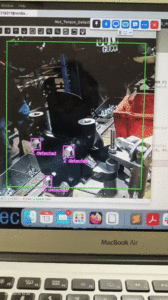
Vision-Based Quality Inspection and Traceability System
Client Overview
Sharda Motors Industries Ltd is a leading automotive components manufacturer, known for its high standards in quality control and production efficiency. To enhance process automation and traceability, the company required an advanced vision-based system for ensuring circlip presence verification during assembly.
Project Summary
The Vision-Based Quality Inspection and Traceability System was implemented at Sharda Motors Industries Ltd to ensure accurate circlip pressing during production. This system integrates with machine vision technology and IoT-based data acquisition to enhance precision, reduce errors, and improve traceability.
Challenges Faced
-
Manual inspection inefficiencies leading to incorrect circlip placement.
-
Production delays due to idle machine time caused by rework.
-
Lack of traceability of individual parts in the assembly line.
-
Quality inconsistencies affecting compliance with industry standards.
Solution Implemented
The Vision-Based Quality Inspection and Traceability System was deployed to address these challenges by enabling:
1. Automated Circlip Presence Detection
-
A vision system detects whether the circlip is properly placed on the part.
-
If the circlip is detected, the system sends a forward command to the cylinder, allowing the circlip to be clipped onto the part.
-
If the circlip is missing, the system prevents further machine operation, ensuring quality compliance.
2. QR Code Generation and Scanning for Traceability
-
Once the circlip is successfully clipped, a unique QR code is generated containing:
-
Unique ID
-
Date & Time
-
Part Details
-
Vendor Details
-
Shift Information
-
Production Count
-
-
The QR code is printed and pasted on the part to ensure traceability.
-
Before the part is unclamped, the QR code is scanned to confirm all details are correctly registered in the system.
-
Once validated, the machine releases the part and is ready for the next cycle.
3. Data Acquisition and Cloud-Based Traceability
-
All inspection data, QR codes, and production logs are stored securely on the cloud.
-
Data is accessible in real time via a dedicated URL for production monitoring.
-
Daily production analysis reports are emailed to registered recipients.
-
Quality reports, production reports, and maintenance alerts are shared via email and mobile notifications.
Key Business Impact
1. Increased Production Efficiency
-
Machine idle time was reduced by 1 hour and 50 minutes, leading to a significant boost in production output.
2. Reduction in Rework & Quality Issues
-
The vision-based system eliminated manual inspection errors, ensuring 100% accurate circlip placement.
3. Enhanced Traceability & Compliance
-
Each part is now uniquely identified with a QR code, ensuring full traceability throughout the supply chain.
4. Real-Time Data Access & Decision Making
-
Management teams can access reports anytime from any location, enabling data-driven decisions.
-
Automated alerts improve response time to production or maintenance issues.
Conclusion
The Vision-Based Quality Inspection and Traceability System at Sharda Motors Industries Ltd has significantly improved production efficiency, traceability, and quality assurance. By leveraging machine vision technology, IoT, and cloud-based data management, Sharda Motors has successfully optimized machine uptime, reduced errors, and enhanced production workflows.
This successful implementation highlights how vision-based automation can revolutionize quality control in automotive manufacturing by eliminating manual errors and increasing process efficiency.
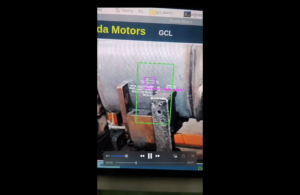
Vision-Based Arrow Direction Detection on Muffler for Automated Welding
🏭 Industry
Automotive Manufacturing – Exhaust / Muffler Welding Line
🧩 Problem Statement
In the muffler welding process, correct orientation of the muffler is critical.
Each muffler has a directional arrow marking, and welding must start only if the arrow direction is correct.
Earlier, this verification was:
- Manual
- Error-prone
- Causing incorrect welds and rework
The client required an automated, reliable, and PLC-integrated vision solution to ensure zero welding on wrongly oriented parts.
🎯 Project Objective
- Detect arrow marking on the muffler using a camera
- Identify arrow direction (Left / Right / Correct orientation)
- Send OK / NOT OK signal to PLC
- Allow welding operation only when orientation is correct
🛠️ Solution Overview
We implemented a Vision-Based Arrow Detection System with real-time PLC communication.
System Flow:
- Camera captures muffler image before welding
- Vision algorithm detects arrow marking
- Arrow direction is calculated
- If direction matches reference:
- PLC receives OK signal
- Welding operation starts
- If direction is wrong:
- PLC blocks welding
- Operator intervention required
🧠 Technical Approach
- Edge-based arrow detection
- Direction vector analysis
- ROI-based processing for high speed
- Noise-resistant logic suitable for welding environment
Key Highlights:
- Works under industrial lighting
- Robust against dust and surface reflections
- Fast decision-making suitable for cycle-time constraints
🔌 System Architecture
- Industrial Camera mounted near welding station
- Vision Processing System (Industrial PC / Jetson)
- PLC Interface via Digital I/O / Ethernet
- Welding Machine Interlock
📊 Results & Benefits
✅ 100% prevention of wrong-orientation welding
✅ Zero manual inspection required
✅ Improved weld quality and consistency
✅ Reduced rework and scrap
✅ Seamless PLC integration
✅ Industry-ready and scalable solution
🏁 Conclusion
This project demonstrates how Vision + PLC integration can eliminate human error and enable fully automated, decision-driven welding operations.
The solution is production-proven, scalable, and adaptable to other orientation or marking-based inspection tasks.